
Les Joynes
FormLAB
FormLAB: Witnessing Creativity as It Happens
Creativity, in the account that follows, is treated not as a possession — a talent one either has or lacks — but as a capacity: a muscle whose exercise gives us the agency to bring into being what does not yet exist. FormLaboratory (FormLAB), which I began in London in 1997, developed out of this premise as an ongoing artistic and research practice. It started as a studio-as-laboratory experiment: an attempt to turn the studio inside out and render visible what ordinarily happens behind the closed doors of artistic production. Creativity, on this account, is not simply the making of an artwork. It is the capacity to imagine, experiment, respond and construct — the agency to enter an uncertain space and begin forming something that does not yet exist. FormLAB creates the spaces, structures and encounters in which that capacity can become visible.
The Studio Turned Inside Out
The traditional artist's studio operates, in many respects, as a black box. An artist works privately, develops a body of work over time, and eventually presents the finished results in a gallery or museum. This is the arrangement the French artist Daniel Buren addressed in his 1971 essay "The Function of the Studio," which described the studio as the "first frame, the first limit" on which every subsequent frame of exhibition depends — a private, stationary site of production whose objects are destined for a public, mobile afterlife elsewhere (Buren, "The Function of the Studio," 1971). My own interest lay one step earlier than Buren's: not in the studio's function as a site of production, but in what happens before a finished work exists — when artists visit one another, exchange ideas, respond to what they see, experiment with materials and shape one another's direction.This became a formative part of my development as an artist at Goldsmiths, University of London. Rather than treating the studio simply as a place where objects are produced for later exhibition, I came to see it as a space of encounter: a site where a thread of dialogue moves between artists, and where one person's experiment can become the catalyst for another's. FormLAB grew out of this recognition — the premise that what happens in the studio can itself become the work.FormLAB is accordingly not a style of artwork or a fixed method of production. It is a lens: a way of looking at creative activity. Its transparent structure renders process visible. Raw materials enter a space; people interact with them, with one another, and with the circumstances surrounding them; a series of actions unfolds. Those actions produce discrete objects, images, installations and other forms, but the objects account for only part of what has taken place.The resulting process may resemble an impromptu performance, but it is not a stylized one. It is reactive: each action responds to a situation, a material, another person, or an unanticipated development. The work therefore exists simultaneously as action, relationship, space, object and memory. It resides in what happened between participants; in the physical environment that made those encounters possible; in the discrete objects and images that emerged; and in the memories carried forward by audiences through photographs, publications and the objects themselves. The objects become, in effect, talismans of the act — physical traces of something that happened.
From the Ontology of Art to the Laboratory
This line of inquiry became the subject of my doctoral research (2008–2012), which examined cross-cultural collaboration, geographically dispersed artistic practice, and the relationship between artistic process, place and production. During that research I held a Visiting Scholar designation in Philosophy at Columbia University, where I began examining questions concerning what constitutes an artwork and how the boundaries between form, object, process, artist, audience and context might be understood. That inquiry led me to conclude that an artwork is always perceived through systems — institutional, discursive, cultural — and I wanted to understand how art, and creativity more broadly, operates across those systems.
The question is not new to art theory. Allan Kaprow's happenings had already, by the late 1950s, proposed that art could consist of an unrepeatable event rather than a durable object (Tate, "The Happening"), and Nicolas Bourriaud's 1998 account of relational aesthetics later described a body of practice that takes "the whole of human relations and their social context" as its point of departure, rather than an independent, private symbolic space (Bourriaud, Relational Aesthetics, 1998). FormLAB shares this horizon of concern but approaches it from a different angle: not the choreography of a social situation as artwork, but the deliberate exposure of the generative process itself — the sequence of decisions, responses and materials — as a legitimate object of witness.
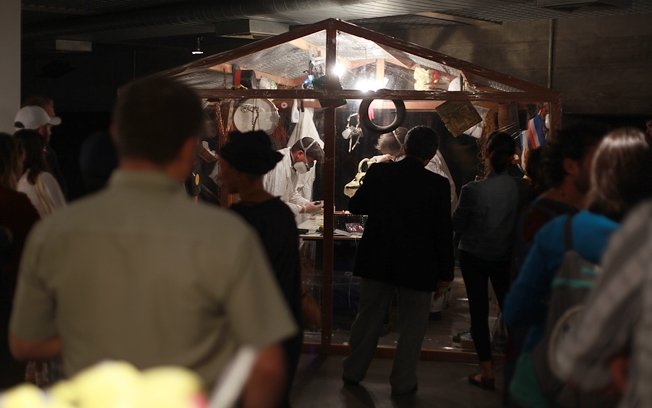
This research informed a FormLAB project at the Museum of Brazilian Sculpture (MuBE) in São Paulo, where I built an on-site laboratory inside the museum so that visitors could witness art being made rather than encounter it only as a completed object. Materials, artists, cultural perspectives, actions and encounters unfolded within the museum itself, in full view of its public.
Asked, at the time, what constituted the final artwork, I concluded that it was not one thing but many. It included the installation within the museum; the transparent structure that made the process visible; the performative acts of making; the objects that emerged from those actions; and the writing, photography and moving image that documented them — and, just as importantly, the memory the project left behind.
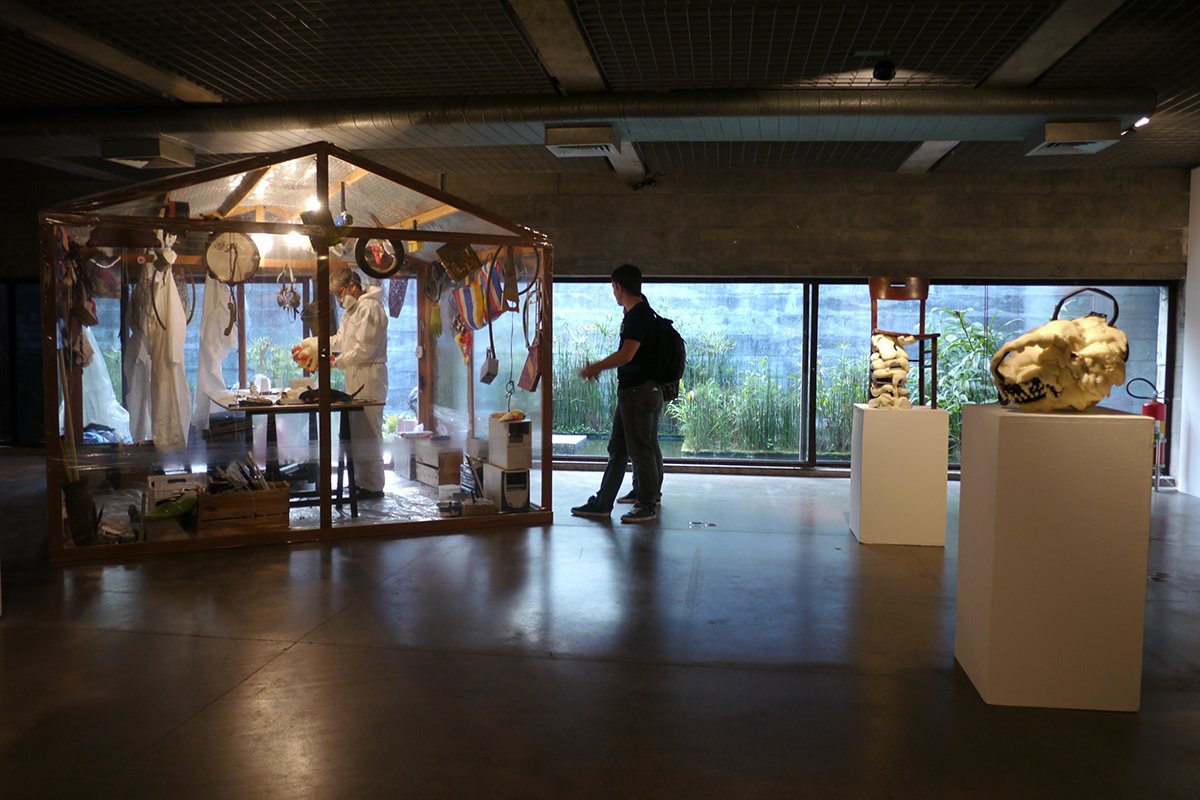
FormLAB - Sao Paulo
FormLAB created US-Brazil collaborations at the Brazilian Museum of Sculpture, Sao Paulo, Brazil. 2023-2026 © Les Joynes, ARS New York and DACS London.
The Energy of the Unexpected
Across nearly thirty years of developing FormLAB in different cultural settings, one of my most durable observations is that something occurs in the process that cannot be fully predicted from the outcome.
There is a difference between extending an existing body of work incrementally — refining it, making it more recognizable, aligning it more closely with the expectations that surround it — and allowing a creative process to yield something genuinely unforeseen. Both modes have their value, but they generate different kinds of energy. My interest lies in the tension between coalescence and disruption: the forces by which forms become established, and the forces that pull them apart. In physical systems, entropy describes a tendency toward increasing disorder, while energy input can produce temporary structure, pattern and organization. Artistic practice contains a comparable tension. Established forms supply coherence, but creative acts can dissolve those forms and generate new ones. The unexpected carries a particular vitality precisely because it has not yet been absorbed into a system.
Discussing studio visits with American artist David Hammons, Hammons described his preference for seeing what an artist was working on now, rather than encountering only the accumulated work of the past — a.k.a. the studio's "graveyard." What matters are the things that are still alive, still becoming. I encountered something similar when a German artist friend visited my studio in New York. I had begun showing him the paintings in a series then underway, one after another, when his attention was drawn to a canvas turned to face the wall. It was not among the works I had intended to show: unfinished, its surface marked by circular forms I had stripped back with a palette knife and rubbed with turpentine, leaving flat, opaque, moon-like shapes behind. To me, this had been simply an act of removing what was not working, in preparation for something new. My friend saw something else entirely in the gesture. Those circles became, in his eyes, moons — and the work eventually became Four Fathers (below). It evolved from something I had not consciously intended. Sometimes the beginning of a new work is hidden inside the act of abandoning an old one.
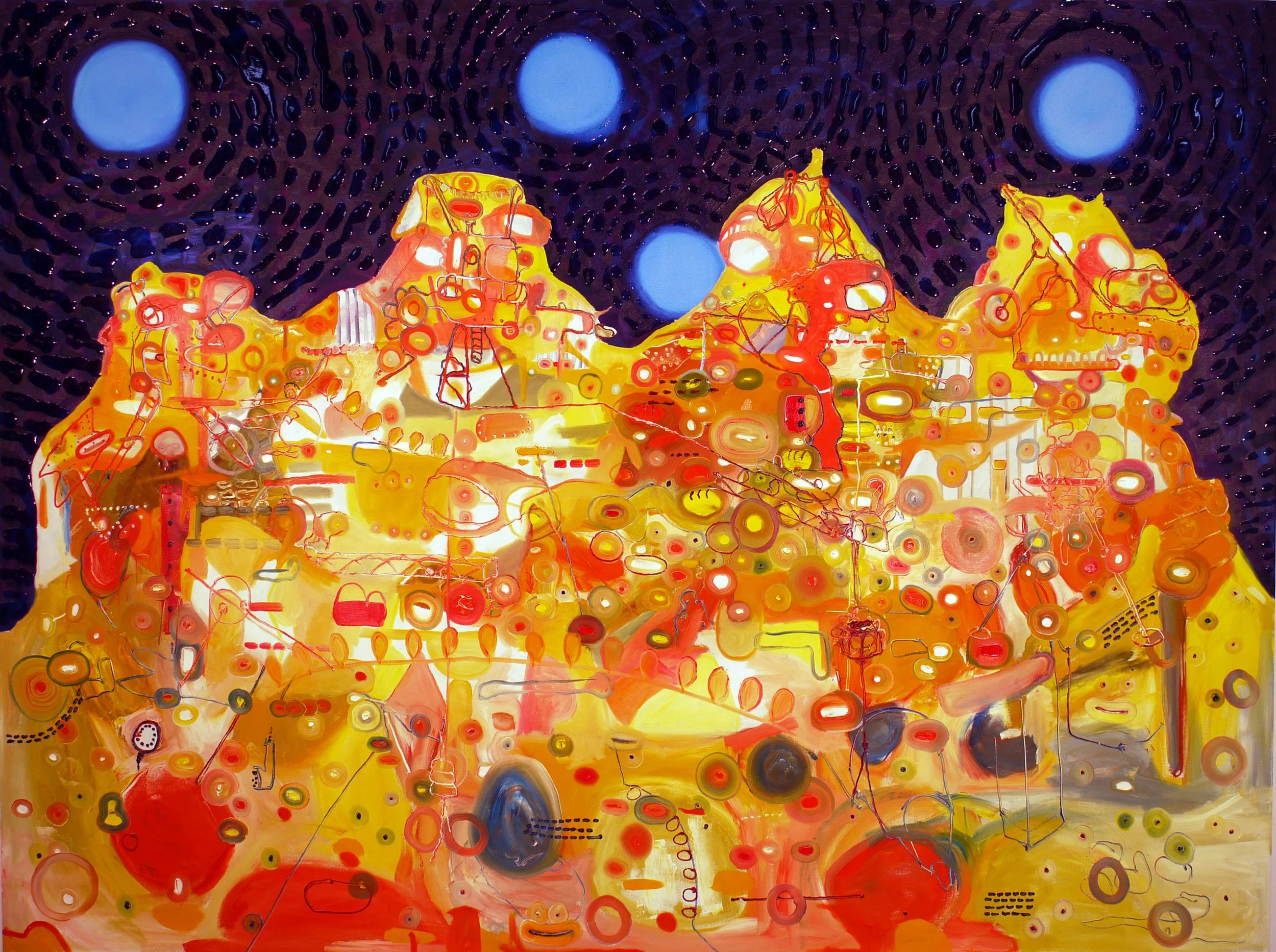
Four Fathers (2011) Oil on Canvas, 54 x 72 in. © Les Joynes, ARS New York and DACS London.
Creativity Across Cultures
Since much of my life has involved moving between cultures, cross-cultural encounter became a natural extension of FormLAB.
For me, living within another culture produces a temporary suspension of one's assumptions. Language offers one of the clearest instances of this. When I first lived in France, I spoke only some French; as I became fluent, my relationship to the culture changed. I acquired, in effect, another way of experiencing the world — almost a second body, retained alongside the first.
The same process recurred through living in Germany, the UK, Belgium and Japan, and through subsequent work especially in Asia. Each culture supplied another lens through which to experience the world. But something is also lost as the outsider becomes an insider: the distance that once rendered everything strange begins to disappear. I became interested in preserving some measure of that space of not-knowing.
When another culture remains partly unfamiliar, perception can sharpen. Language becomes almost abstract; gestures, materials, rituals and assumptions become things to observe rather than take for granted. The unfamiliar opens a space in which habitual ways of seeing loosen their hold. This space between the familiar and the unfamiliar has affinities with what Jacques Derrida described through différance: meaning generated through difference, and continually deferred rather than settled into a single, fixed interpretation. For me this is not merely a philosophical proposition but an experiential condition. To encounter another culture is to encounter another way of making sense of the world — and potentially another version of oneself. FormLAB uses artistic practice as a vehicle for entering that space, posing the question: what happens when we allow ourselves to see through another person's lens?
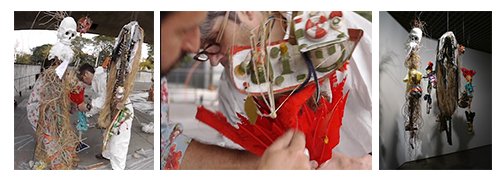
FormLAB performance incorporating ritual into sculpture (2012)
FormLAB at the Brazilian Museum of Sculpture, Sao Paulo, Brazil. 2012 © Les Joynes, ARS New York and DACS London.
Creativity as Agency
The lessons drawn from FormLAB extend beyond the production of artworks. The same creative capacity that allows an artist to experiment with an unfamiliar material can allow a teacher to imagine a new curriculum, a researcher to approach a problem differently, an organization to re-examine its assumptions, or an individual to navigate technological change. This is why my work has increasingly moved across art, education, innovation, coaching and technology.
Turning the traditional studio inside out, FormLAB stages transparent environments in which the raw process of making becomes visible to an audience rather than concealed behind a finished object, a practice tested across cultures from São Paulo to Tokyo and grounded in my research. What happens when the private act of making is opened to public view? What is gained — and lost — when the unexpected is allowed to disrupt what is already known? And how do we create the conditions in which people, in any discipline or culture, can move beyond what they already know?
About Les
Les Joynes (PhD) is a multimedia artist, researcher, and coach, and founder of FormLAB, a nomadic experimental laboratory that has staged live art-making inside museums and public spaces in the americas, Europe and Asia.
A Fulbright Scholar in art and performance in India, he is a recipient of U.S. Public Diplomacy Awards for Mongolia and China and the Monbusho/MEXT Award in Japan. Les holds an MA in Fine Art from Goldsmiths, University of London; an MA from Musashino Art University, Tokyo; a PhD in Fine Art from Leeds Metropolitan University; and postdoctoral studies at the University of São Paulo and University of the Arts London. He is a Visiting Scholar in Modern and Contemporary Art History at Columbia University and has lectured across Asia, Europe, and the US. He has curated and produced exhibitions and performances in Brazil, Japan, South Korea, Mongolia, China, Singapore and India and served on the curatorial team for the inaugural Taipei Biennial.
His work has appeared at the Norimatsu Museum, the Barbican, Michael Steinberg Fine Art, Thomas Jaeckel Gallery, the Art Gallery of New South Wales, the Inside Out Art Museum in Beijing, and the Museum of Brazilian Sculpture in São Paulo, among many others. As a creativity and leadership coach he mentors founders at New Inc (New Museum) and is an Innovation Coach with the European Innovation Council. he is based in New York.
Notes:
Daniel Buren, "The Function of the Studio" (1971), first published in English translation in October, no. 10 (Fall 1979): text
Allan Kaprow originated the "happening" as an unrepeatable, event-based art form in the late 1950s: Tate, "The Happening"
Nicolas Bourriaud, Esthétique relationnelle / Relational Aesthetics (1998): Tate, "Relational aesthetics"

Earth/ Balance, Great Wall, China (2017). 2009-2025 © Les Joynes, ARS New York and DACS London.

Les Joynes, Shifting 0.00000000103279% of the Great Wall (2017), China. 2009-2025 © Les Joynes, ARS New York and DACS London.
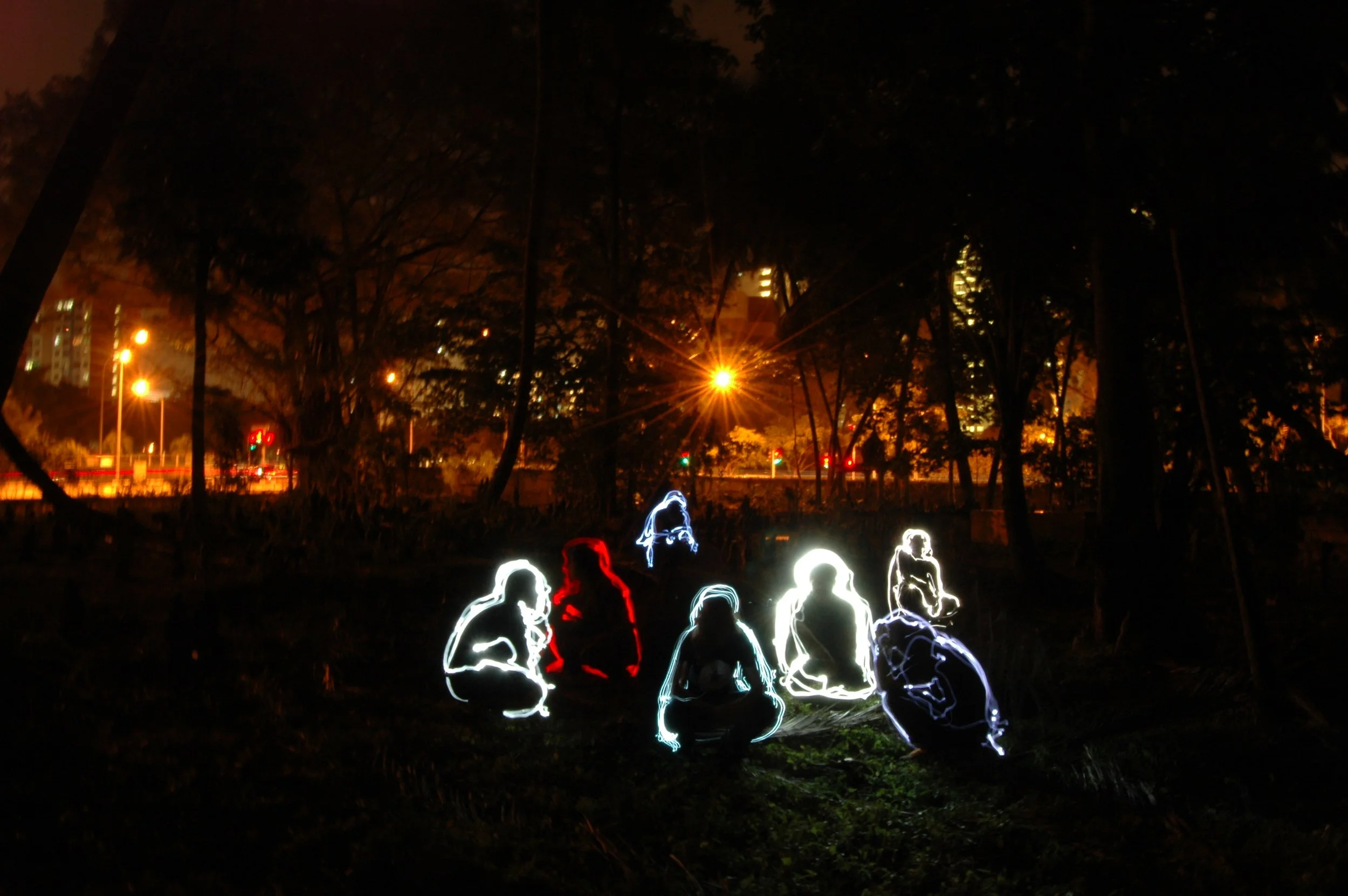
FormLAB performances in Singapore (2009) with La Salle College of the Arts and Nanyang Academy of Art. 2009-2025 © Les Joynes, ARS New York and DACS London.

FormLAB explores the layered colonial histories of Taiwan with the exhibition Sugar (2024), ByWood Gallery, Kaohsiung, Taiwan. 2009-2025 © Les Joynes, ARS New York and DACS London.


Site specific video work exploring the city of Sao Paulo in Brazil - still images of Sleeping in República (São Paulo) (video 3 min, 2013), 2023-2025 © Les Joynes, ARS New York and DACS London.

FormLAB explores nomadic reindeer communities in Northern Mongolia as part of a Fulbright-Hays US public diplomacy project. Still from Shapeshifter (Mongolia) 2014.video 2 min 56, 2014 © Les Joynes, ARS New York and DACS London.

Discussion on Joseph Beuys and Andy Warhol with a Reindeer n Khovsgol, Mongolia (2014), chromogenic print. © Les Joynes, ARS New York and DACS London.
Joynes’s work has featured at the National Museum of Taiwanese Literature (2023), ByWoods Gallery, Kaohsiung, Taiwan (2023), Douba Film Festival, China (2019), Inside Out Art Museum, Beijing (2017), Museum of Brazilian Arts (MAB-FAAP), Sao Paulo, Brazil (2015), Zanabazar Museum of Fine Art, Ulaanbaatar, Mongolia (2014), 976 Gallery, Ulaanbaatar, Mongolia. Launch for Venice Biennale (2014), Fundação Armando Alvares Penteado, São Paulo (2013), Brazilian Museum of Sculpture, São Paulo (2012), Seoul Foundation for Arts and Culture, Korea (2012), Fenberger House Museum, Nagano, Japan (2012), Gallery Thomas Jaeckel, New York (2011), Welsh Museum of Modern Art, UK (2010), Treignac Projet, France (2010), Bauhaus, Dessau, Berlin and Queenstown, Singapore (2009), Åmotgård Museum, Bygstad, Norway (2008), Michael Steinberg Fine Art, New York (2008), New General Catalog, New York (2007), CBGB New York (2006), Space, London (2005), Romo Gallery, Atlanta (2005), Mizuma Gallery Tokyo (2005), Bergstübl Mitte, Berlin (2004), Mars, Tokyo (2003), Tactical Museum/ AIT, Tokyo (2002), Art Gallery of New South Wales, Sydney (2001), Nylon, London (2000), Asahi Contemporary Art 2000, Tokyo (2000), Bangkok Experimental Film Festival, Bangkok (1999), Tatsumi Orimoto Space, Kawasaki, Japan (1999), Casa, Tokyo (1998), Norimatsu Museum, Japan (1997), Milch, London (1996), Barbican, London (1995).