Les Joynes
b Santa Barbara, California. Lives and works in New York

Art writers today are called to move fluidly between the familiar and the unfamiliar, the idiosyncratic and the interconnected, the coherent and the contradictory. In a cultural moment shaped by fragmentation and acceleration, criticism must cultivate nuance and interpersonal understanding alongside intellectual precision. I am committed to writing that holds care and critique in productive tension — where the interrogative and intuitive, the perceptive and imaginative, coexist without collapsing into certainty.
My name is Les Joynes. Active as a research scholar at Columbia University since 2009, I have studied with Jonathan Crary (histories and futures of the museum), John Rajchman (critical theory), and Alexander Alberro (modernism). As a 2025–2026 scholar in Modern and Contemporary Art, I am researching critical perspectives on the formless with Rosalind Krauss, co-founder of October. This sustained engagement with the formless informs my approach to criticism as an open field — one that resists closure and invites sustained encounter.
My formation as both artist and writer has been shaped by artists who model intellectual rigor alongside curiosity and humor. Conversations with Andy Warhol about kitsch and flea-market found objects sharpened my attention to the rich material cultures that always surround us. Studying grid painting with James Rosenquist refined my understanding of scale and fragmentation. At Goldsmiths, my teacher Michael Craig-Martin opened up the poetics of space and the charged intervals between things. Studying alongside Korean artist Jung Yeondoo at Central Saint Martins and Goldsmiths deepened my appreciation for how artists expand frontiers through curiosity and wit.
My research and artistic practice have unfolded transnationally. In South Korea, I have examined artistic investigations into the life cycle of recyclables in Seoul, tracing how material afterlives complicate systems of visibility and value. In Mongolia, I have explored intersections between contemporary creative practice and shamanic ritual, attending to forms of knowledge that exceed Western critical frameworks. In China and São Paulo, I have engaged projects that transform everyday and institutional spaces into experimental public sites. Across these contexts, I am drawn to practices that test the boundaries of medium, authorship, and audience.
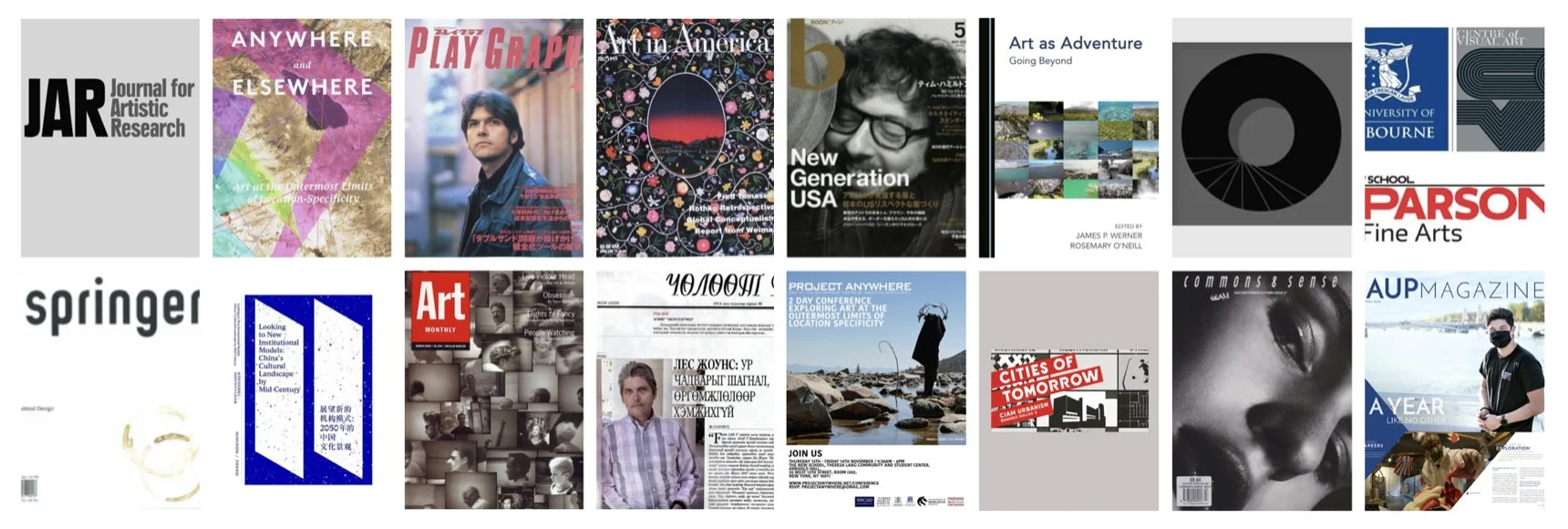
This trajectory is inseparable from being an artist. I have always been — and will always be — an artist. Writing, for me, is a parallel creative act: a way of framing, attuning, and extending the encounter with art. My essays have appeared in Art in America, Flash Art, the Journal for Artistic Research, and Museum 2050. I have also served on the editorial board of Project Anywhere, the first journal dedicated to site-specific art.
The Artlab Editorial Fellowship’s commitment to critical empathy aligns closely with my practice. I am eager to contribute writing that is rigorous yet responsive — work that deepens dialogue across geographies and invites readers into sustained, imaginative engagement with contemporary art.
The impact of this fellowship on my writing practice
Participating in Artlab would meaningfully deepen this trajectory by placing my writing in sustained editorial dialogue with a community committed to rigor, experimentation, and critical empathy. The fellowship’s collaborative structure would push me to refine my voice — clarifying argument without foreclosing ambiguity, and taking formal risks that allow structure and method to emerge from the artwork itself. Engaging closely with peers and editors would strengthen my ability to translate complex artistic practices for diverse audiences while preserving their nuance. In this way, Artlab would not simply support my work; it would actively challenge and expand it, sharpening the balance I seek between care and critique and inspiring writing that remains attentive, responsive, and alive.
Education and Research
2025–2026 – Visiting Scholar on critical approaches to avant-garde practices with art critic Rosalind Krauss, Department of Art History, Columbia University
2018–2020 – Visiting Scholar on aesthetics, technology, and subjectivity with Jonathan Crary, Meyer Schapiro Professor of Modern Art and Theory in the Department of Art History and Archaeology at Columbia University.the future of museums with museum critic , Department of Art History, Columbia University
2014–2015 – Postdoctoral Fellow, School of Communications and Arts (ECA), University of São Paulo - research on collaborative practices within Afro-Brazilian traditions
2012 – Taiwan Ministry of Education Scholar, National Cheng Kung University - Scholar on Taiwanese culture.
2008-2012 – PhD, Faculty of Art, Environment and Technology, Leeds Metropolitan University
1996–2001 – Masters in Fine Art, Musashino Art University, Tokyo (Monbukagakusho Fellowship Japan)
1996-1997 – MA Fine Art (Art and Theory), Goldsmiths, University of London
1993–1996 – Postgraduate Diploma (ons) Fine Art (Sculpture), Central Saint Martins College of Art and Design
Selected Publications
Joynes, L. et al (2023) Memory, monument and the post-Soviet. Indiana University Press. [book]
Joynes, L. (2022). Tohoku: Memory and disaster in Japanese photography. Chithravathi [journal]
Joynes, L. (2020). Review of Reclaiming artists research, Journal for Artistic Research. [journal]
Joynes & Vu (2018). Vojvodina, Serbia Museum of Contemporary Art. [cat].
Joynes, L., et al. (2019). In China’s cultural landscape by mid-century. Long Museum [book]
Joynes, L. (2018) FormLAB in Art as Adventure. Cambridge Scholars [book]
Joynes, L. (2016). Geographically dispersed performance. Universidade de São Paulo [dissertation]
Joynes, L. (2015). Anywhere v.1. In Lowry, S. et al. (Eds.), University of Melbourne. [book]
Joynes & Zheng (2015). CCTV China.[interview]
Joynes, L., & Vu, M. (2015). In Draw: Artists from China. LeRoy Neiman Foundation. [cat].
Joynes, L. (2014). In Art research at the limits of site specificity. University of Newcastle. [book]
Joynes, L. (2008). Multi-spatial performance at Bauhaus [online article]
Joynes & Basu (2011). Journal for Visual Culture. University of California Press. [journal]
Joynes, L. (2001). Yuichi Higashionna: Hina Gata. Flash Art [magazine]
Joynes, L. (1999). Some Say they Did. Some Say they Didn't Yoshitomo Nara at Ginza Art Space, Tokyo. Art in America.
Joynes, L. (1998). David Thorpe and Briant Griffiths: The New Pathetic: 1990s Contemporary British art. Vienna: Springer.